Sangha by Lexie Wolf
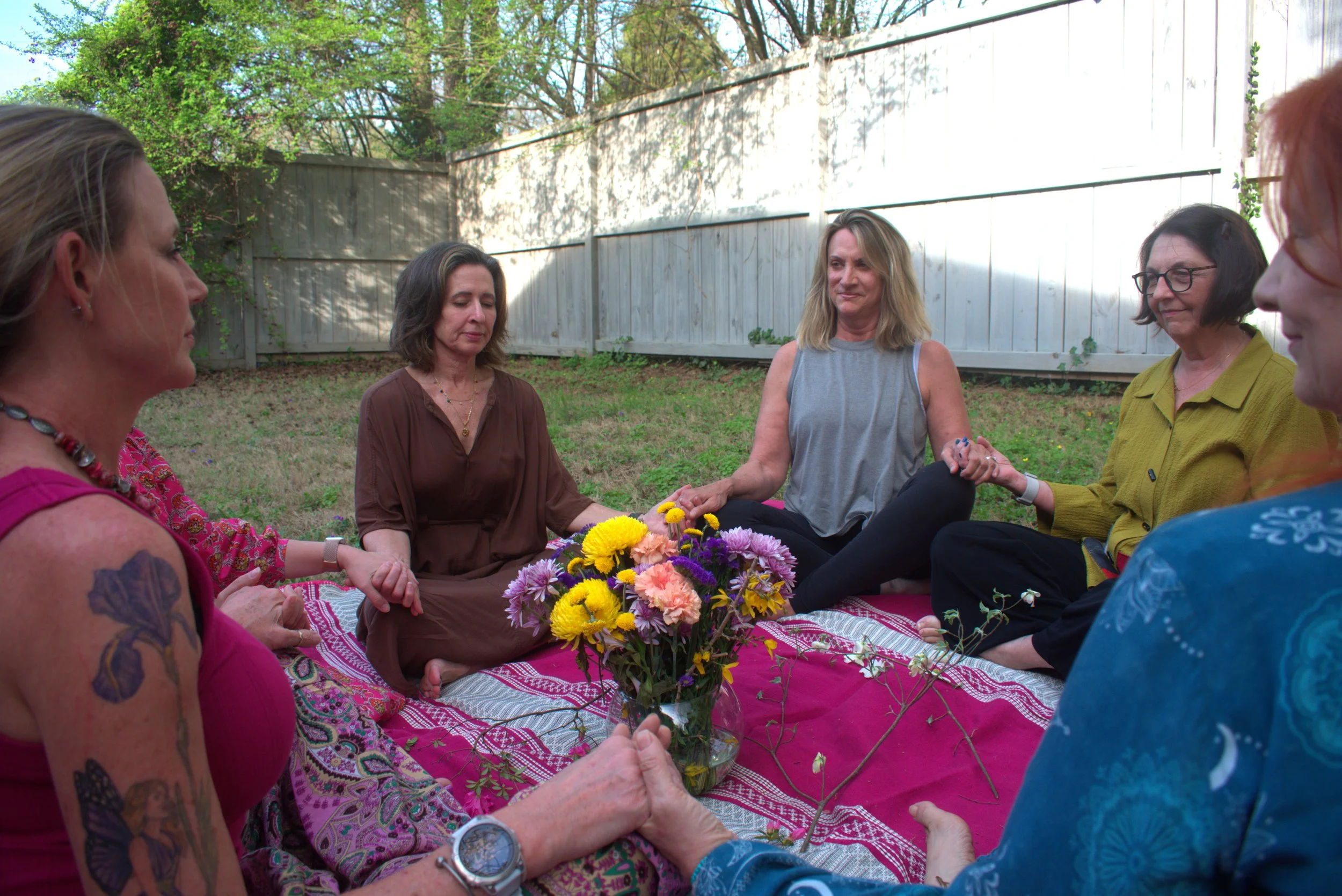
As our four grownish kids build their lives and step out into the world, I find myself returning to the same message: the most important thing to cultivate in life is relationships. They mostly get it. But in the digitally saturated world they were born into, relationships require a kind of intention that didn’t always used to be necessary. And there is not really a single extrovert among us. It doesn’t always come easy. Not at all.
There are many things that make a life resilient. Strong relationships sit at the very top.
I’ve spent a lot of my life as one of those “I can do it myself” people. Fiercely independent. I still go there. But at some point I realized that this quality I was proud of was not always healthy—more a response shaped by believing that I didn’t have someone to depend on.
I could tell the harder versions of those stories. But when I look again, from a different angle, what stands out is not abandonment. It’s how often I was held. Here are two of the most formative:
I was in England my junior year of college, planning to spend spring break at my boyfriend’s home in Wales. The day before break, he got drunk and pushed me into a wardrobe in my dorm room. I wasn’t seriously hurt, but I was shaken. The dorm emptied out as everyone left for the holiday, and I sat there alone, unsure what to do.
Later that evening, I heard voices in the hallway—unexpected in an otherwise silent building. There were students gathered in the dorm kitchen, cooking together. The smell alone was enough to pull me out of my room.
They welcomed me in immediately. A group of international students, mostly from various countries in Africa, staying on campus for the break. I was private by nature, but I was vulnerable in that moment. I told them what had happened, and without hesitation they folded me into their week. Into their hearts.
We cooked (they cooked, I mostly ate), laughed, wandered, sang, shared stories. It remains one of the most unexpectedly joyful weeks of my life. By the end of it, I felt light again. Steady. Not alone.
Years later, when I separated from my then-husband, I found myself in another moment I hadn’t seen coming. Two young kids—seven and ten. A full-time, not very flexible job. Graduate school at night. No family nearby. And suddenly, no partner at all. He disappeared for a time due to severe mental health challenges and never really returned to parenting.
I was truly terrified.
I was living in a neighborhood in Holly Springs that felt a little more conventional than I did. I wasn’t sure I belonged there.
Looking back, that detail feels almost irrelevant. Because when my life unraveled, those were the people who held me.
Three women on my cul-de-sac—Jenny, Rieppe, and Nicole—became my lifeline. They showed up in ways I still struggle to fully put into words. They cared for my children when I couldn’t be there—which was often. Loaned me cars when mine broke down and I had to get to work and school. Brought meals. Made the impossible feel survivable.
I don’t know what that first year would have been without these women. I’ve told that story at women’s circle.
I imagine—hope—that you have your own versions of these stories. Many of them. Moments where the village carried you.
Most of the messages I’ve been receiving about Yoga Garden speak to this same thing. Yes, people talk about the practice. The teaching. The ways yoga has supported them. But more than anything, they talk about the community.
The Sangha. In many Eastern traditions, including yoga, the Sangha is the community of practice—the people who walk the path alongside you.
I’ve hesitated to use the phrase “spiritual community” to describe Yoga Garden. It’s always mattered to me that this be a place where anyone can walk in and feel at home, no matter how they relate to yoga. No matter what faith they identify with—or none at all. Yoga is not a religion.
But it has been a spiritual community for many. Because while the teaching matters—and it does—it’s not the main reason people stick around. Most people can get high-quality yoga instruction online now—and that’s a good thing. Accessibility is good.
What’s not as easy to find is this:
A place where people are known.
Where they are met with care.
Where, in the middle of a hard season, they are held.
Call it whatever you like. When it is rooted in love, it becomes something more.
And if I look back over my own life—at the moments that shaped me most—I can see it clearly.
Again and again, I remember: I am held.