Remember by Lexie Wolf
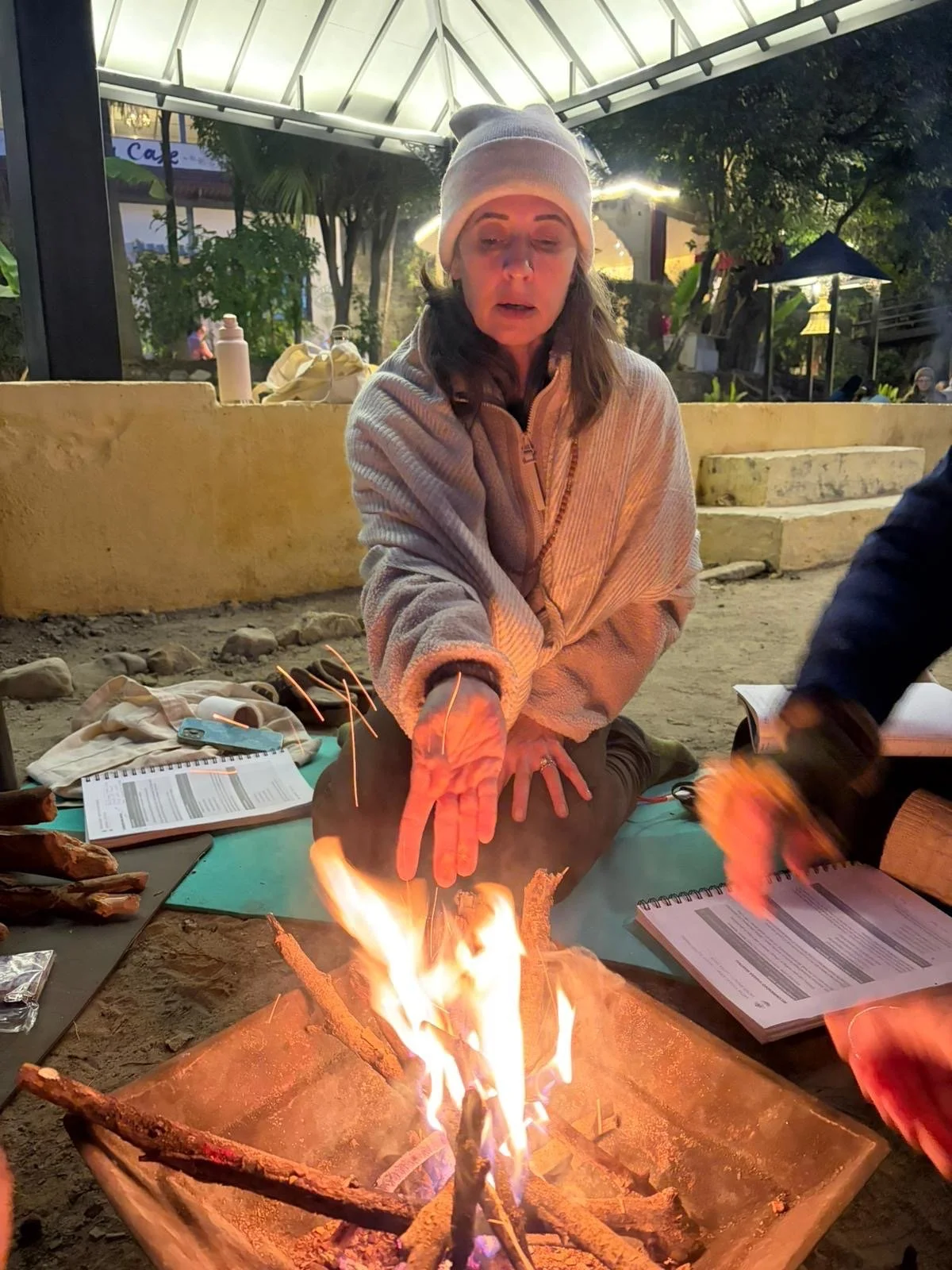
Early in the training we were asked to form small practice groups of five. A simple logistical moment. After a quick huddle, Bill and I decided to join separate groups, to broaden our perspectives.
I somehow found my way into the sweetest little Sangha I could imagine. We have bonded with ease. We’ve supported one another through long hours of practice, through four out of five of us getting sick, through the inevitable waves of an intense training. We eat many meals together. We laugh often. Between the steady presence of Bill and the care of this small circle, I feel so held and supported.
Recently we completed our teachings on Vedic fire ceremonies, called Yagya. For several days we all smelled of smoke and incense, wandering the grounds with armfuls of wood and copper trays filled with offerings: water in a copper pot, flowers, food, incense. Sulfur and ghee poured carefully from a long-handled spoon. The fire itself is lit in a special copper vessel called a Kunda.
As with everything here, we begin with understanding, context, wisdom. Fire represents transformation, the spark of creation, the most powerful of the elements. Fire ceremonies exist across nature-based traditions the world over. A Yagya is a conscious, ritualized act, meant to align energy and intention, to gently invite cosmic intelligence in a particular direction. Each ceremony holds a purpose, or marks a moment. As a full group, we participated in a Yagya for a holiday honoring the goddess Saraswati, supported by the pundits (priests) here—more elaborate, more formal, and deeply beautiful.
Each small group then led five Yagyas, so that everyone could experience holding the role of guide. For several mornings and evenings, at twilight and just before dawn, the riverside grounds were dotted with eleven small fires. Chanting rose softly from every direction. Smoke curled into the trees. It felt timeless. Like something humans have always done.
Leading ceremony is not simple at first. There is an opening puja (ritual) to perform in a particular way. A fire to tend. Mantra rounds to count on a mala. An offering to place into the fire with each chant. It is a lot to hold. We chose to make it collaborative—one person tending the fire, another keeping count, all of us sharing the responsibility. These moments became some of the most intimate for our Sangha. Primal. Quietly powerful. Connecting us to one another and to something much older than us.
We speak often here about the importance of Sangha—about how essential it is to have community and relationships that uplift us, that share our values, that help us remember who we are when we forget. We all know this in our bones, don’t we? And we also know what it means to sit around a fire with other humans—in ritual, in story, or in silence. This may be one of the most powerful ways to reconnect with what is and has always been.
So much of what we do here feels like an act of remembering. Remembering how to listen. Remembering how to move slowly and with intention. Remembering what it feels like to belong—to my own soul, to the people walking beside me, to the elements, to the living world expressing itself through me. Clearing away the noise and the unnecessary to uncover what is already here: space, silence, clarity.
And I remember.
Can this kind of remembering happen at home, too? Of course. It begins with choosing what matters, and shaping our lives in ways that support that choice. Bill and I—and my Sangha—are sitting with these questions as we move into the final days of our training.