Living Our Yoga by Lexie Wolf
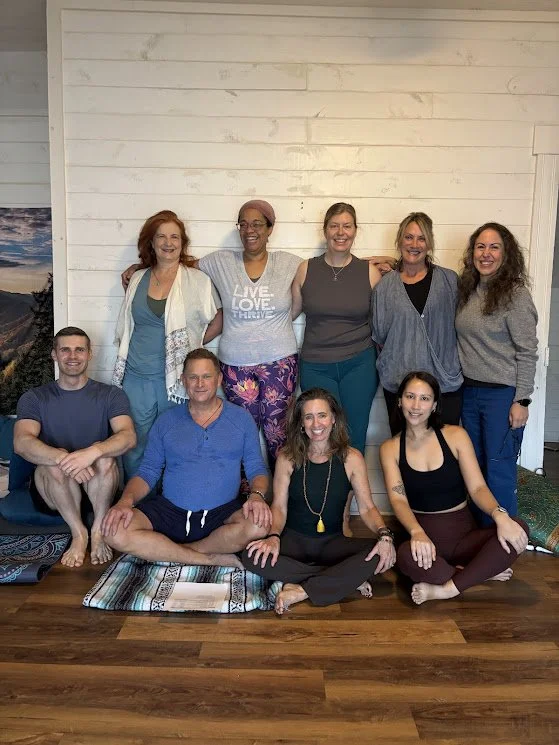
At the start of our most recent yoga teacher training weekend, we gathered in our usual sharing circle and reflected on how the past month’s work had gone. The work of our yoga teacher training, above all else, is learning how to live our yoga.
We talked about how living according to yogic principles in today’s world often requires some resistance to mainstream culture. To be content in a world that is trying to keep you thinking you aren’t enough or don’t have enough. To stay mindful and calm in a world that wants nothing more than to distract and wind you up. It’s no surprise that yoga’s rise in popularity in the West was shaped, in part, by the counterculture of the sixties.
Weighing on my mind during our conversation was some news I had just heard on NPR—that my alma mater Hampshire College was closing. Hampshire was itself a sixties experiment, and I was lucky to receive a wonderful education there in the early nineties. There were no big lecture halls, no fraternities or sororities, no football team. There was an excellent Ultimate Frisbee team, and it is entirely possible that some students chose Hampshire for its legendary “Trip or Treat” Halloween event. My friends Sue and Molly and I attended in our first year as the Ego, the Superego, and the Id. (I was the Id, in case you’re wondering. You’re probably not.)
As the New York Times wrote on April 14, “The school’s philosophy was that it was more important for students to learn to solve intellectual problems than to memorize facts.” Check. I still know few facts. However, Hampshire taught me how to think critically, look deeply, and to feel a sense of responsibility to the world around me. When NPR interviewed filmmaker Ken Burns, one of Hampshire’s more well-known alumni, he said, “There’s an extraordinary list of accomplishments among Hampshire graduates. But often you find it’s a schoolteacher in Colorado doing something that’s helping people in a kind of, you know, silent way.” I loved that. It feels very true to the spirit of the place.
I credit this education with helping me to reinvent myself more than once. I rarely knew exactly what I was doing at first, but I could usually figure it out—or make it up—as I went along. Yoga Garden was no exception. There was and is a strange kind of joy in jumping into the deep end and learning to swim. It was messy, and I made tons of mistakes, and I’m grateful for all of them, most of the time.
Hampshire didn’t hand us a path. It expected us to create one for ourselves. Yoga is like that. It asks us to stay awake. To pay attention. To question what we’re being told and to look a little more deeply for ourselves. To move through the world with some intention, even when it would be easier to drift. It’s no wonder I was drawn to yoga later—and to all the creative, independent, and deeply caring people who have made up our Yoga Garden community. Here there was a kind of belonging that isn’t about sameness, but about a shared orientation toward living with loving awareness.
As I ponder my next chapter after the studio closes, I’m relieved that my reinvention doesn’t have to be a major one. Wherever I am, I will still be living my yoga. Or at least trying to. As will all of you.